
|
Archive for 2010
Thursday, December 30th, 2010
Don’t forget about the original design: http://www.corbinstreehouse.com/blog/2010/12/plug-bug-battery-box-design/
I did modify it slightly as I went along. I learned a lesson from the front box: add 1/8″ or so to the total length to avoid it from being too tight. I started the rear box by welding up the bottom piece. I also used this piece to figure out where it would attach to the frame. I ended up using the rear seat belt mounting points and also the side seat belt mounting points; those worked out perfect!

The box is quite large, and just barely fits into the car. I had made a cardboard version first, but I was worried it wouldn’t fit in (but it does!).
Next I made the top piece — it is too pieces of angle iron welded to 1/8″ thick flat stock on the ends:

I had to do the ends twice; originally it was too tight (again!) and I had to move them to the outer side of the angle iron, which actually worked out better for strength.
The initial trial fit seemed to indicate the whole box was like 1/2″ too large; so, I removed 1/4″ from two places, thinking that would be perfect. In the end, that was too tight (again!!). I could fit the cells in, but I couldn’t drop them in vertically, and I just needed a little more wiggle room.

After a few cuts and re-welds I did a trial fit of the box in the car:

I then used some angle iron to fill in the vertical pieces to add strength:

It took me a while to get these in and straight: I had to cut the tack welds on one side and redo them in a better position (with some hammer persuasion).
Finally, a trial fit in the car:

Also notice the rear batteries; they will sit on this little mount, and be strapped to it to prevent movement in the Z axis:

The back section ears are for mounting the lexan cover on top — they perfectly align with the battery box right in front of it. The rear set consists of 5 cells strapped together between two 1/8″ sheets of aluminum plating:

The rear box after painting metallic silver (that’s what I did all today!):

Tomorrow will be a fun day; the boxes will be be installed and batteries will be slid in place!
Posted in Electric Bug
|
Comments Off
Thursday, December 30th, 2010
I’ve been working on fabricating the battery boxes out of 1/8″ steel angle iron and flat stock for the past two weeks. The first step was to strap them together to get an accurate measurement of the size of the batteries when as a group. I then went to SIMs metals in downtown San Jose and picked up some steel. I ended up needing more 1/8″ aluminum plate for the cells, and ordered another 4′x4′ piece from Reliance Metal Center up Union City, CA. I also needed some sheet metal, which I was going to get at SIMs but I figured I might as well just pick it up there while I was driving up. I got a full 8′x10′ 22 gauge sheet — the smallest they would sell me, for about $43. I could have bought 4 small pieces at Home Depot for $10 each…but I figured it would be nice to have the spare steel around. The crazy part is how it was packaged — sandwiched between two thick pieces of cardboard and placed on heavy duty palette made out of 12′ four by fours! Great packaging, but a little excessive. I was planning on rolling it up in the back of the truck, but it was nice to have it all secure!

Onto the battery boxes. Here’s the front box as I went along:


A trial fit turned out to be just too darn tight! I built it right to the size it needed to be…but it needs to have some play to get the cells in it (and back out!).

So, opted to cut it in half and weld in 1/8″ spacers. That made them fit; albeit still a little tight, but they do go in:

NOTE: The picture about is showing only two straps on the two right banks of cells — I later added the third strap.
Next, I did some trial fitting in the front trunk. I added about 1.5 inches on top with cardboard to make sure I would have enough clearance for the mounting hardware (straps, BMS), and a lexan cover.

It seemed to fit just perfectly if I sunk it as low as it would go in the front area, and have it hover just over the steering wheel column.
I used two C-clamps to secure a piece of angle iron on the front and then welded that on:


The picture above also shows my idea of strapping the cells down in the Z axis (vertical). I don’t want the cells to move around when I go over a bump, nor do I want them to fly out the top if the car happens to flip over in an accident. I’ve heard of other people using tie down straps, so I simply attach them to the side pieces of metal I bent to act as a nice hold down. This will also help cinch the cells up tight to help expansion issues.

In the above picture, you can also see the two front holes drilled to mount the box to the frame. I simply used the existing gas tank bolt holes as they were in just the right location.
<< Fast forward a few days — I worked on the rear box since I didn’t have the sheet metal at the time. >>
I wanted the front box to be 100% sealed from the elements. I made a mold out of cardboard to cover up the side area as a little wing. I then traced it onto the sheet metal and cut it out with the jig saw. The jig saw was a pain; I really wish I had a nice metal band saw!

There’s also a large piece on the bottom:

The completed welds — the bottom of the box is facing to the left. The front of the box is facing up. The “wings” are on the left and right side.

Top view:

Positioned in the car — it completely covers up the area that the gas tank was in.

Also note that the above picture has little ear tabs on each of the four corners; these will be used to mount the Lexan piece on top.
The final step, was to paint it. I used the same metallic silver paint as I used on top of the bug. There are (sort of) two coats of primer, two coats of color, and two coats of clear. All I did today was paint all the boxes:

The rear box will be detailed in the next post…
Posted in Electric Bug
|
1 Comment »
Monday, December 27th, 2010
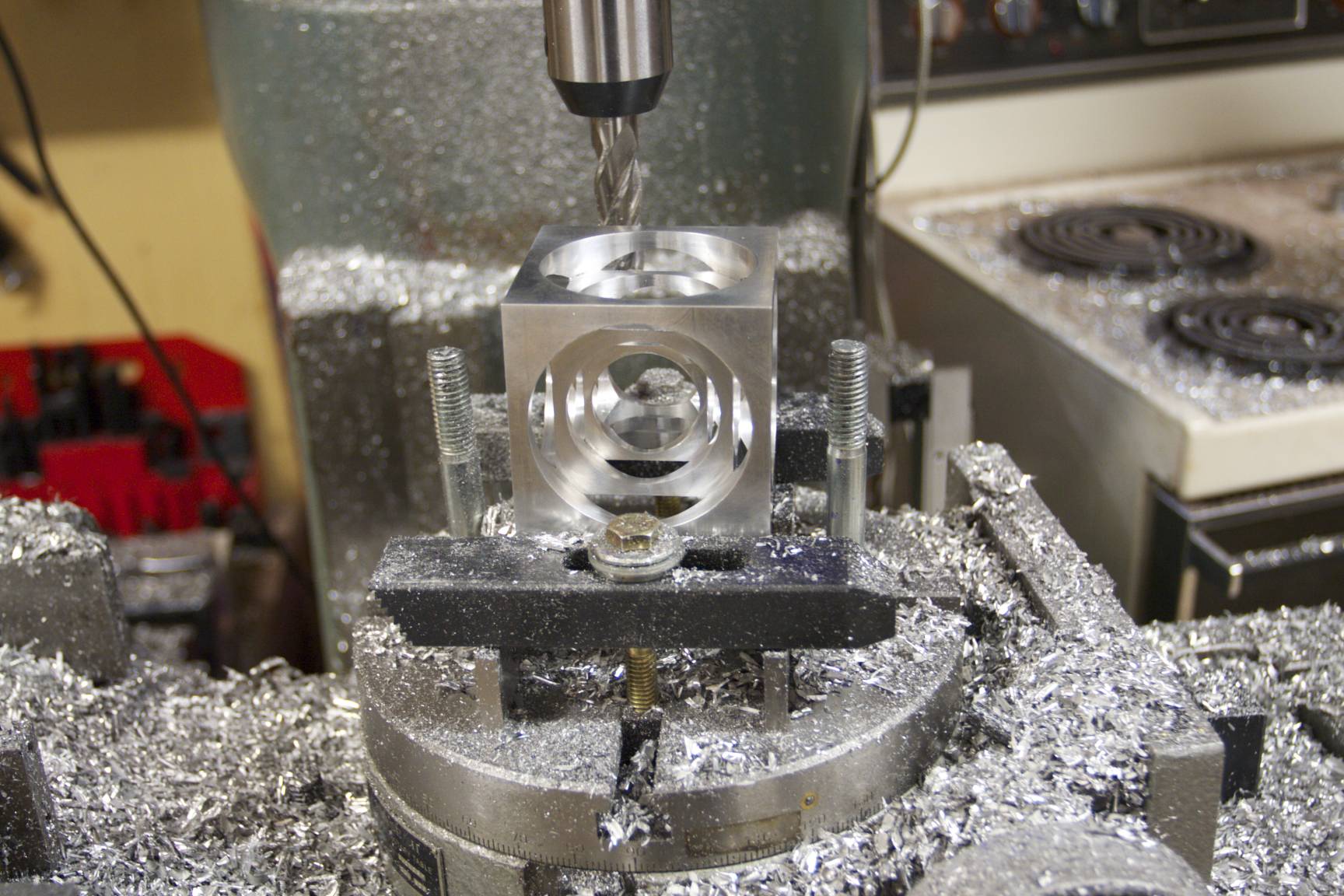
Tuner’s Cube. I made it for my dad for Christmas 2010. Aaron helped me over Thanksgiving break to figure out the details and did some machining on it too. It started out as a ~3.5″x3.5″ solid square piece of aluminum.

We made a jig to hold it so it could be removed and place back in again at the same position but on a different edge.

The rotary table on the mill was used to turn it out:


Second half of the jig — this was Aaron’s idea, and it worked great. Just use a piece of mild steel with a hold cut into it and clamp it down on top.

Lots of chips:

Posted in Machining
|
Comments Off
Monday, December 27th, 2010
Here’s a wine glass rack I made for my dad’s wife, Karen. I made it a while ago, but it was a Christmas present, so I couldn’t post it till after the 25th.


It is made out of 1/4″ diameter mild steel round stock.
I bent each top piece by hand, freestyle around a little jig. I welded each one to the other one at the base. To cover up the welds, I wanted to curl some of the round stock around it; I tried to pre-bend it by hand, but that wasn’t working. Instead, I started by tacking the top portion on (as seen below at the top of the wrap). I then took the oxy/acet torch and heated the stuff up until it glowed red and then just wrapped it around again and again, sometimes using a hammer to get it to go a little tighter. That worked great, but it makes me want to make a forge to more easily make stuff like this.

The bottom spiral I also bent by hand, using the same jig which I had around for my railing.
It is covered with some spray-can semi-gloss clear coat.
Posted in Machining
|
1 Comment »
Thursday, December 23rd, 2010
Here’s how I strap the Thundersky batteries together.
As previously mentioned, I bought the Mini Polyester Strapping Kit 5/8″ x .040″+seals + tools for $80 (plus shipping) on ebay.
The pack of 4 (or 5) cells is squared with a regular square. Be sure to line up the terminals in the direction you want them. I ended up restrapping one cell again. Actually, I did it twice; I actually strapped it back together in the same configuration that I took it apart in (doubt!).

Tape on the end pieces (1/8″ thick aluminum sheet). Twice I forgot to do this and had to restrap the bottom one again.

Cut the strap with some excess:

Put the strap in the bottom of the strap tension tool:

I dremeled out little sections to allow the strap connectors to sit (somewhat) flush:

Strap lined up with the tool and brought up to tension with the ratcheting mechanism:

Clip slipped on over the slot and the crimped on with the crimper tool. After crimping, but before cut-off, I file the rough part of the edge off.

Finished strap:

A whole lot of cells (this is most my rear pack):

Posted in Electric Bug
|
6 Comments »
Wednesday, December 22nd, 2010
The unladen weight of the stock bug is 1807 lbs. The gross vehicle weight is 2645 lbs. Front axle load: 1080 lbs, rear: 1609 lbs. The front axle had the 10.6 gallon tank removed — when full, 10.6 gallons is about 66 pounds (6.25 pounds per gallon of gas). The engine, I’m guessing, was about 250 pounds (fairly easy to move with just two people). I probably removed an extra 100 pounds in other various components: rear seat, drum -> disc brakes, generator, smaller 12v battery, etc. So, my starting empty weight: about 1391 lbs, giving 1254 lbs of payload. Each battery weighs 16 pounds (I originally planned on them being 13 pounds…which was wrong — that was the weight for the 160ah cells, not the 200ah cells). I have 48 of the 200ah cells to distribute between the front and the rear. That is 768lbs are batteries! That leaves 486 lbs to reach gross weight. The Warp9 is 143 lbs. That leaves 243 pounds. I weigh 140 lbs. That leaves about 200 pounds, which probably accounts for all the other stuff I put in (controller, DC-DC converter, wires, battery boxes). Based on these numbers, I’m glad I’m removing the rear seat; the bug would be quite a bit overweight with 4 people in it!
Posted in Electric Bug
|
Comments Off
Sunday, December 19th, 2010
I did some research on what people have done for battery boxes. The cells need to be contained well so they don’t go flying around in the event of an accident. A few interesting posts I found:
http://www.diyelectriccar.com/forums/showthread.php?p=186991 — some good pictures.
Battery Boxes for the Adventure EV – a 1971 Land Rover, with nice boxes.
I knew I wanted to make my boxes out of steel, similar to Travis’ bug. I wasn’t sure how thick of steel to use, so I asked on diyelectriccar.com with this post. That also was a great way of seeing some other boxes that I hadn’t seen before. I also learned that 1/8″ steel was probably thick enough. I was originally thinking 1/4″ was way too thick, but I was pondering 3/16″. Since others used 1/8″, and said it worked well, I decided to use it. I also settled on 1″x1″ angle iron.
Now, I designed battery boxes months ago for the 160ah size cell. However, my 200ah cells turned out to be bigger, so I had to rethink things. With the 160ah cell, I was going to put a bunch behind the rear seat and the rest in the front trunk. Here is the 160ah battery design sketchup file and some screen shots.
This is the rear pack of 31 cells — it was going to sit quite high, but it wouldn’t obstruct the rear window at all. I was going to secure the cells in the x direction by using the same strapping stuff that I used to secure the cells together. The cells would have been mounted horizontally, which is okay but not ideal. I had emailed Thundersky batteries and they said mounting horizontally is possible, but vertical is better — mainly because if the batteries vent (due to too much heat/expansion), they will vent out the top and spill.

The front pack, 17 cells:

The real 200ah size was quite larger, so I had to rethink things. I finally realized the car was going to be fairly heavy with all these cells (a post on that is coming soon), so I decided to just nix the rear seat. I rarely have a second passenger, and I even more rarely have 3 or 4 passengers in my current car. More often than not, I use the rear area of the Prius to carry unicycles. I decided that I could nix the rear seat and cover it with Lexan and toss the unicycles on top of the batteries. It should work out great!
So, here’s the 200ah size design I’m working on fabricating. Note that I leave off some details, like side braces that I (might) add later depending on how strong it feels.
The front pack, 15 cells (each cell is 16 pounds, so that’s 240 pounds in the front trunk area — much heavier than the gas tank normally would have been):

The blue area above is roughly the available floor area that I could use to put the cells.
The rear pack (33 cells), which will sit where the rear seat was, along with a small set of horizontal cells sitting on the rear luggage area. The entire area should be about level, and will all be covered with a few big pieces of thick Lexan plastic.

The rear pack has angle iron on the top pieces to create a flat area to mount the lexan onto, and also possibly some strapping mechanism to strap the cells down. I haven’t decided how I want to secure these cells in the Z axis. The rear cells will be strapped down for sure, but I’m not sure about the front — I might make a latching mechanism for them.
Feel free to download the sketchup files and play around with them. I did a lot of revisions in Sketchup before I came to these designs; mainly playing with layouts, locations, and designs.
Note that the cells have a 1/8″ aluminum plate on the ends — that is used to secure the cells from expansion.
Posted in Electric Bug
|
1 Comment »
Sunday, December 19th, 2010
I’m a little behind on the status of the project…I got the batteries on Dec 8th, but was really busy that week due to Louise’s show, Left of the North Pole.
It was a pain getting the batteries; the guys at the warehouse had some miscommunication and I had to drive up to the place twice, wasting a bunch of gas in my truck and an hour+ of my time. Oh well!
The bad news: they are bigger than I anticipated; I was hoping for 200ah cells in a “160ah case”. But, I’m making it work by removing the backseat out of the car.

I didn’t order the hardware to save some money; I figured I could make my own straps and copper bus bars. Plus, the configuration they come strapped in wouldn’t work for what I was previously planning.
I took some 1/8″ aluminum to make as end plates for the cells. The cells have to be tightly compressed, as they expand during use.

I bought on ebay a Mini Polyester Strapping Kit 5/8″ x .040″+seals + tools for $80 + $20 shipping. 1600 lbs breaking strength. Those should be plenty strong enough. Unfortunately the tensioning mechanism wasn’t working! I took the thing apart and realized it was put together wrong by the manufacturer — I had to flip a little ratcheting mechanism to get it to work right. I then strapped the cells into packs of 5 for the front battery pack (more on that design later):

Here’s all three cell groups for the front pack:

The right most group has a little handled on top so I can move it around. Aaron gave me an idea on how I can use some climbing webbing and make it look nicer and less obtrusive. I need to have a strong handle that I can use to drop the cells into the battery box, and also use it to lift them out.
Posted in Electric Bug
|
Comments Off
Saturday, December 4th, 2010
My batteries are in California! I just need to have the guy call me to pick them up. I’m dying to get them and put the car together, but in the meantime here’s what I did.
I’m going to make this into a sticker that goes inside the “gas” cap:

Edit: A better png version. Email me for the photoshop file.

Posted in Electric Bug
|
2 Comments »
Thursday, December 2nd, 2010
I wanted to have a good sound system in the car. I bought an Alpine stereo and a set of speakers. I was initially going to mount them in the doors, but I read that is bad idea for several reasons. For one, the door panels are rather weak, and a hard door slam could throw the speakers out. Second, the doors are made to get wet inside, and I don’t want the speakers to get water damage. Luckily, I ran across some “front speaker panels” on jbugs.com and ordered those. I bought 6.5″ component speakers and I was hoping I could figure out a place for the tweeters if they didn’t fit in the speaker panel. However, I made them fit and here were the steps.
I figured out roughly where the panels would go. Here’s the driver’s side:

The ’69 bug has a heater vent lever on the post mount. The panel wasn’t fitting quite right with it on, so I removed it. I put it back on later on top of the panel, and that seems to work great.
I made a template for the speaker and tweeter and cut out holes. I put the speaker location as deep a location as it could go in the panel. The big hole was cut out with a jig saw, and I used a hole saw for the small tweeter hole.

Despite the location, I still had trouble with the back of the speaker hitting the back of the bug. Purists, shut your eyes: I just took a hammer and hammered out the wheel well area from inside the bug to give me more room. That worked. then covered it with some carpet/sound deading material. It was simply glued on with spray adhesive glue from Home Depot:

The above is also a great picture of the accelerator pedal. It is just mounted with 3 bolts/nuts.
The panel is then bolted on with some provided sheet metal screws. I first drilled a 1/8″ pilot hole.

Piece of cake! it only took all day to do this and the basic wiring/install of the stereo.
And the speaker mounted:

I’ll carpet over the speaker panel once I get all the High Voltage wiring done.
The stereo itself fit into the dash with some slight modifications. I had to cut down the metal slot a little bit with a dremal to make it fit. Installing the wires was a piece of cake compared to everything else I’ve done so far.
Here it is powering the iPad:

The head unit is an Alpine CDA 117 and the speakers are Alpine Type-R SPR-17S 6.5″ components. I’m not super happy with the head unit and I mainly picked it because it was supposed to have good iOS support. It can control the iPad/iPhone okay, but it is really slow to seek from one song to another. If I preset my songs before plugging it in, then it works alright. I can (purchase!) an external input that lets me plug it in with a traditional 7mm jack; I’ll probably do this so I can control the songs with the iPad itself (it is such a faster way of doing it!). Another thing that wasn’t so good was that the bluetooth was another $100 or so. I bought that too, and it actually works great! I can use airplay to play over bluetooth from the iPhone or iPad. The sucky thing is that I can only connect to one bluetooth device at a time; and it *must* be my phone because hand’s free calling is the main purpose of having it. The other kicker is that the head unit charges the iPhone fine, but doesn’t emit enough amps to power the iPad! Ug…darn it. I’ll have to get another power source. I probably could have gone for a cheaper stereo, as I’ll probably be using it mainly for FM and bluetooth, and not much else. The Alpine CDE-103BT might have done everything I wanted for the price of the bluetooth add on for the CDA 117! …but sound quality might have been worse.
Posted in Electric Bug
|
Comments Off
|
|