Solving CNC Chip-Out: Theory on Why, and Real World Examples with Solutions
Video Link: Solving CNC Chipout with Real World Examples.
CNC woodworking can be daunting. You try some toolpath to cut out your project, and the wood has severe chip-out to the point where you have to start again. I’ve been in this boat many times, and but I also try to think about what is happening when I get chipout and what I can do to solve the problem.
I thought it’d be a good idea to cover a lot of what I think about when I am trying to solve chip-out (aka: tear out or tear-out), and the video walks through my thought process in some real world cases.
My basic considerations involve how we can cut wood with a CNC router. It really all comes down the wood grain, but it is nice to try to setup toolpaths that are agnostic to the grain directions. You basically have these choices or some combination of them:
- Upcut Bit
- Downcut Bit
- Conventional Cut (Counter-clockwise when cutting an outside profile/contour, or the bit is on the Right of the workpiece with respect to the direction of travel)
- Climb Cut (Clockwise when cutting an outside profile/contour, or the bit is on the Left of the workpiece with respect to the direction of travel )
- Cut Across the Grain
- Cut With the Grain
Upcut Bit vs Downcut Bit
Here’s a comparison of the two basic bit types:
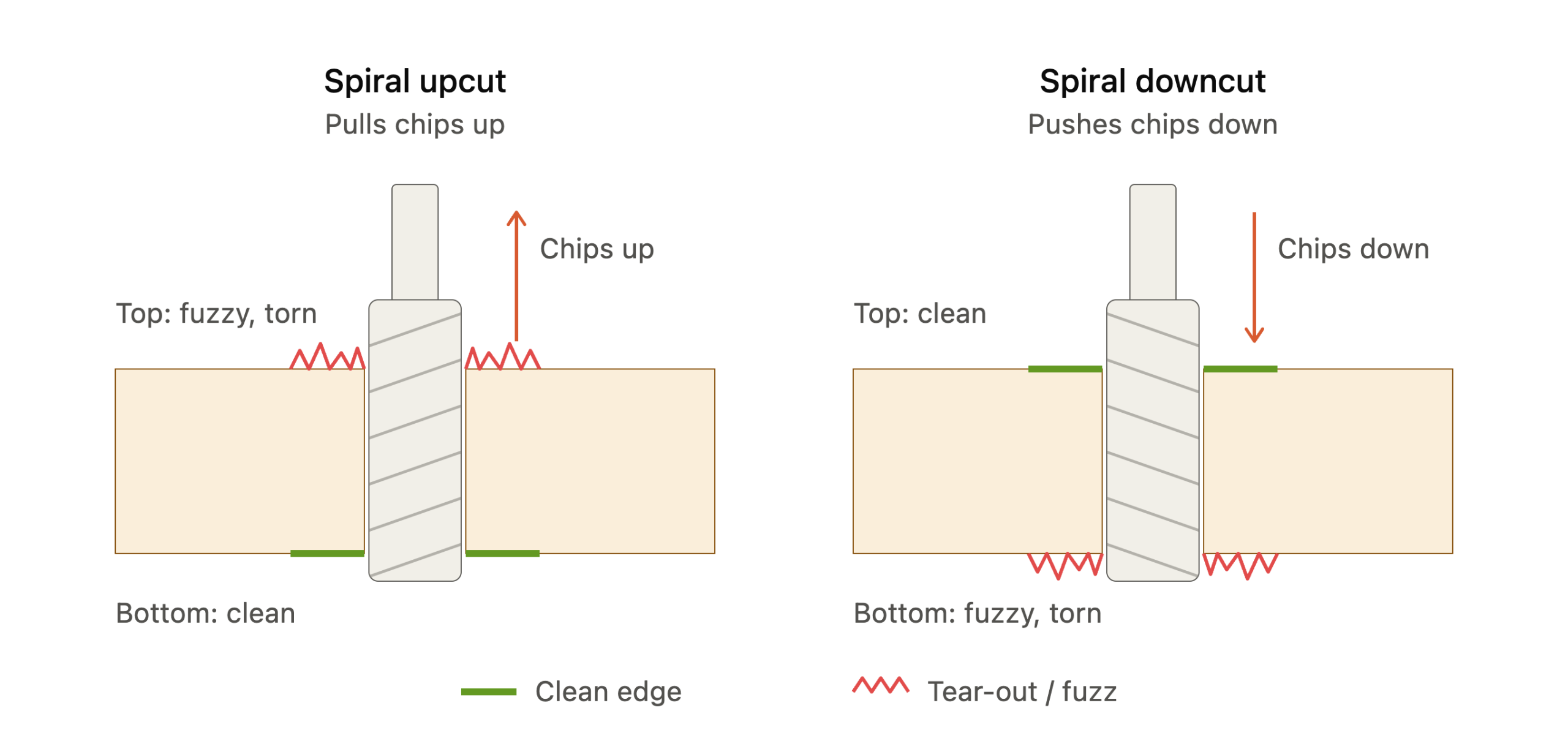
So, an upcut bit is great at clearing chips up and away from the workpiece — especially if you aren’t cutting all the way through the wood. However, it leaves a rough top surface. The downcut bit is great at leaving a clean up, but it will leave a fuzzy torn bottom surface when you cut all the way through. And, having the chips push downwards can sometimes cause issues, such as a bit breaking due to having nowhere for the chips to go.
I generally will “kiss” the top of my workpiece with a downcut bit to make sure it is clean on the top, then come back with an upcut bit to do the rest of the work. This is easy for me because I have an ATC / Automatic Tool Changer, but if you don’t have one you may want to consider a compression bit to avoid the extra bit change work. In a compression bit, the first quarter (or so…it varies) is an upcut bit, and the rest is a downcut. So, if your first cut is deeper than the upcut portion it will leave you with a nicer finish when doing one pass.
The “fuzzy” parts these bits introduce generally aren’t too big a deal to sand off. But I also like to consider the part of the bit that hits the wood first, and think about how that might be causing chipout for some particular problem I’m solving. So a downcut will hit the wood first on the top side and later on the bottom, and an upcut is the opposite. Huge chipout on one particular area might be caused by the bit selection…so consider that!
Conventional Cut vs Climb Cut
One big choice in CNC machining is to do a conventional cut or a climb cut — or some combination of the two. In general, conventional cuts seem to give the best finish in wood, but like a lot of things it depends on the piece of wood, and you can get great results with a climb cut if you have the right speeds and feeds.
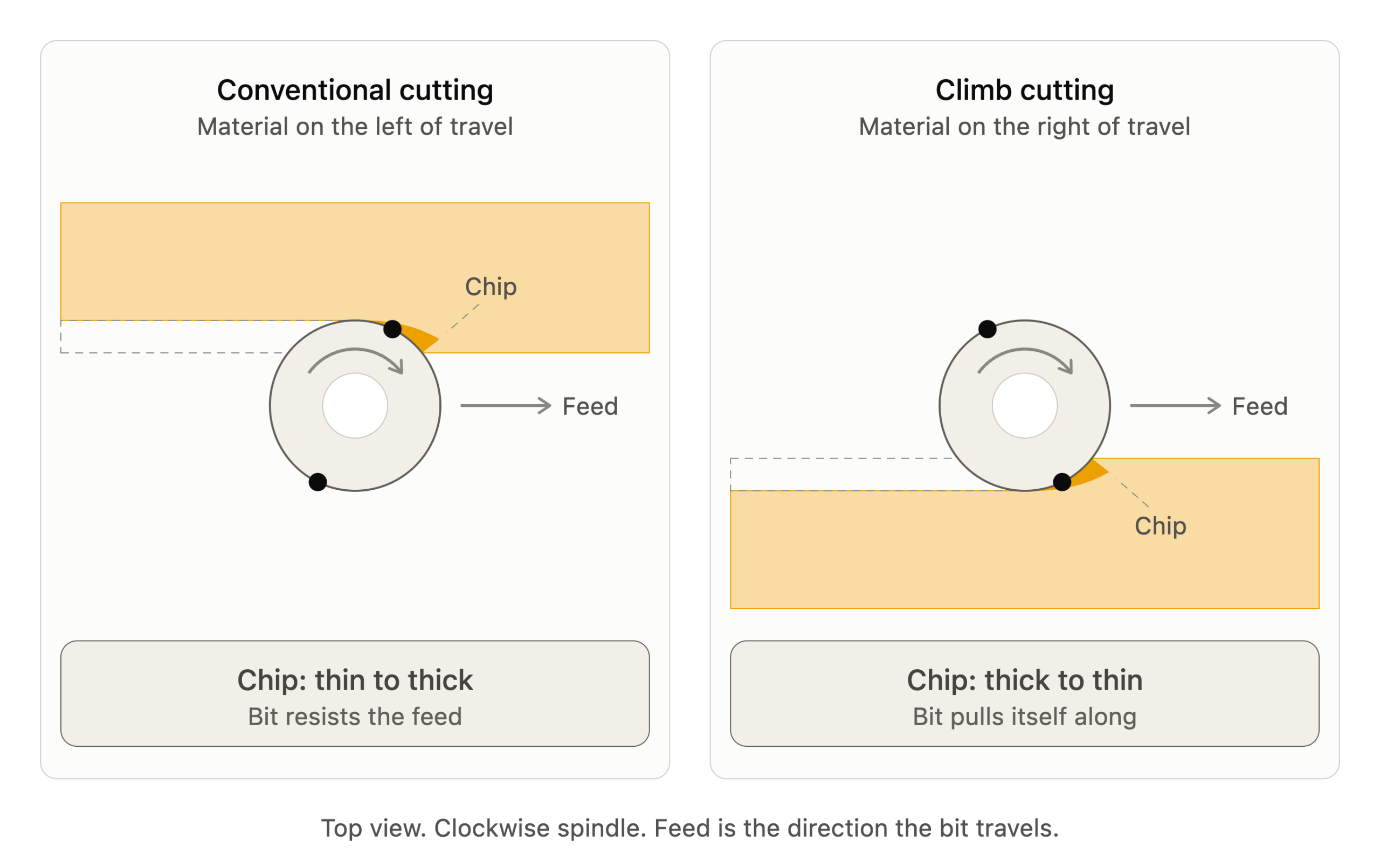
There are a ton of diagrams on the internet comparing conventional vs climb cuts, and a lot of times they would confuse me. The key thing to realize: the diagram is as though you are above your CNC, looking down at the spindle and workpiece. Everything is relative: in the above diagram, the physical machine direction is the same (going from left to right), but it’s all about the side of the workpiece it is on. When cutting a profile (ie: the outside of the workpiece), going counter-clockwise is conventional cutting and clockwise is climb cutting. I was also confused as to why Fusion sometimes calls it Left or Right milling — it is dependent if the material is on the left or right side of the bit. I really don’t like that terminology, because it is easy to confuse — in conventional “Left” milling, the workpiece is on the left but the bit is on the Right. One could have easily called it Right milling because the bit is on the Right.
I just drew a diagram of conventional==counter-clockwise and climb==clockwise and put it on my wall as a reference.
The main thing to noice about each cutting style is how the chip is formed. I think a conventional cut in wood gives a cleaner cut because it always starts out with a small part of the chip…essentially removing a tiny bit of material before a larger amount of material. Whereas the climb cut starts out large…potentially causing more pull out with the grain when it is doing the complete cut. This is just a guess though, but it is important to consider this when you are thinking about why you get tear out.
Across the Grain vs With the Grain
Most woodworkers assume cutting “with the grain” is probably the best thing to do, as that works best when you are planing and jointing wood on traditional machines. However, a router will tend to cause chipout when cutting “with the grain”, as the grain likes to break off along where it runs, and it frequently will run deeper into an area that you don’t want it to chip out.
The general solution is to first cut across the grain, particularly when surfacing large areas, and leave 0.005″ to 0.010″ to finish with the grain. The light ending pass generally avoids the chipout problem because it is so small. You don’t have to do the last step, but I find it leaves less tool marks to have to sand off, and sanding off the ones with the grain is easier.
Cutting across the grain has one big problem: the bit will tend to tear out fibers at the location it exits the wood. The easy solution is to somehow support the wood; either with a jig, temporary backing board, or simply gluing on an extra little sacrificial piece. I like gluing on a little piece of wood, and someone made a great comment on the video: first put some blue tape down to make it a lot easier to remove that piece. This is genius!
Conclusion
The video goes into more detail on how I solve particular problems….but I figured it would be nice to write things out a bit.