Corbin's Treehouse - Corbin Dunn, Santa Cruz, CA
Plug Bug
Treehouse
Photography
Videos
Shop
Unicycling
About

Archive for March, 2011

Some amazing treehouses

Thursday, March 31st, 2011

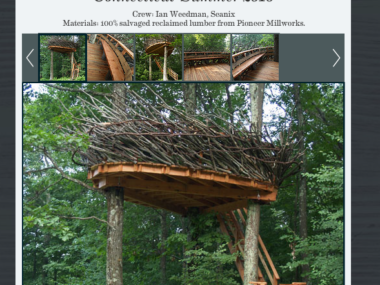
A friend pointed me to a link on MNN with some amazing treehouses. That led me to Romero Studios. They have built some quit amazing treehouse structures, such as the screen shot below. Check them out on their website!

Screen shot 2011-03-31 at 8.38.54 PM.png

Shop Tour

Saturday, March 19th, 2011

How about a tour of my garage shop?

Grinder:
IMG_1002.jpg

Work desk and tools hanging on the wall:

IMG_1003.jpg

IMG_1004.jpg

The fan in the window is used to exhaust fumes from welding and other things:

IMG_1005.jpg

Nuts, bolts and Bengal cat:

IMG_1006.jpg

JET drill press:

IMG_1008.jpg

Metal stock:

IMG_1009.jpg

MATCO welder (I bought it used) and oxy-acetylne setup behind it to the left:

IMG_1010.jpg

Grizzly G0555 wood bandsaw. Works well for the small shop, although a few times I have wanted a wider throat.

IMG_1012.jpg

Grizzly 8″ jointer; I bought a good large jointer, but I have only used it a few times so far:

IMG_1013.jpg

The dust collection system lives behind the garage in a little shed I built just for it. Here is a post when I setup dust collection in the shop. The buttons on the wall turn it on and off:

IMG_1015.jpg

1990 Enco Milling machine. Awesome! I bought it used, but it has been working great since I did some tune ups on the belt.

IMG_1018.jpg

Milling tooling and accessories:

IMG_1019.jpg

Powder coating oven given to me by Eric (thanks!). On top of it is my powder coating supplies. The 50 amp outlet for it on it is also used to charge my car. To the top right of it in the gray box is an American Rotary phase converter than generates 3 phase for the mill.

IMG_1020.jpg

Southbend lathe from the 1950′s

IMG_1021.jpg

Misc storage and stuff:

IMG_1023.jpg

The latest addition; Grizzly 36″ slip roll:

IMG_1024.jpg

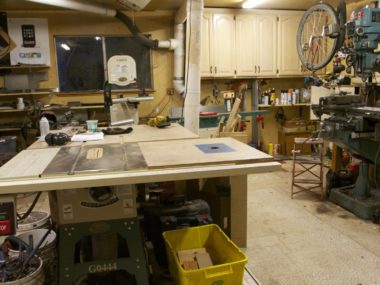
Router table to the right of the table saw. Underneath is a jig saw and router:

IMG_1025.jpg

Grizzly horizontal metal bandsaw with swivel head. One of the most used tools for metalworking, and definitely a must have for doing any kind of metal work. The swivel head is also GREAT.

IMG_1026.jpg

Grizzly G0444 contractor table saw. A little underpowered, and eventually I will get a full size cabinet saw with a riving knife (for extra safety):

IMG_0999.jpg

Overall, I have bought a lot of Grizzly tools. They are fairly priced, and I find the quality to be quite good for shop use. I have had no real problems with the Grizzly tools. They are definitely better than the Enco brand tools (although, the mill I have is of decent quality), and light years ahead of Harbor Freight tools (which I won’t buy, unless it is for a one time project).

Plug Bug: Water proofing the motor area

Friday, March 18th, 2011

One of the problems with the electric motor is that it is exposed to the elements underneath the car. I don’t want to get water in my Warp9 and have it fry, so I needed to do something about it. I first enclosed the area with plastic, and completely sealed it off; definitely water tight, but it seemed to cause the motor to run quite a bit hotter than it usually did. I didn’t like that.

I investigated what other people have done with other bugs. Some solutions involve not driving in the rain. Others are having half the motor exposed, but having a simple splash guard. Others use a blower and blow it into the motor on the brush side. There are kits that can do this; evsource.com has a forced air blower kit. I may eventually do something like that, but dislike forced cooling for two reasons: 1. the fan will be noisy and 2. it will draw power.

So, here’s my passive cooling option that I’m going to do. I’ve used it in light rain, and the motor area stays bone dry. The motor doesn’t seem to get any hotter than it did before. I’m not sure how it would do in really heavy rain, but hopefully it would shed enough water to keep everything okay. The final result has some cooling vents on the side, and exposes the rear slightly to allow air to escape.

IMG_0984.jpg

On the car around the motor:

IMG_0990.jpg

The rear engine exhaust pipe holes now are cooling holes for the electric motor.

Here’s how I made it.

I created a template around the motor out of cardboard:

IMG_0960.jpg

If I had a finger brake, I could bend all the pieces in one go. I bought a little Harbor Freight $40 brake instead, and could only bend the sides. So, I got it out of 22 gauge sheet steel:

IMG_0964.jpg

And used the brake to bend up the sides:

IMG_0966.jpg

IMG_0965.jpg

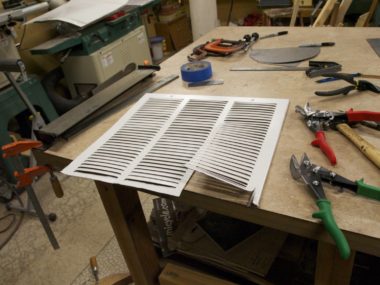
I cut out some pre-made vents from Home Depot (~$11) and stripped the paint:

IMG_0967.jpg

The top on the sheet metal was also bent to use as a mounting area, and the vent location was marked:

IMG_0968.jpg

The side holes should have been cut out before any bending, but I did it after:

IMG_0973.jpg

The vent after stripping:

IMG_0970.jpg

Now, any type of welding on sheet metal is a pain! My MIG welder was melting holes in it too quickly, and torch welding was doing the same with a 0 tip. I needed a smaller 000 tip to do it right. Instead, I brazed it on..which was also tricky to get right and looked ugly:

IMG_0974.jpg

The front piece that covers the motor area was also brazed on; also a pain to get on:

IMG_0976.jpg

I cleaned it up with water, filing, grinding and sanding:

IMG_0979.jpg

You can’t really see it, but in the above picture there are some drain holes drilling in to allow any water that does get in to seep out.

I powder coated it red:

IMG_0981.jpg

It barely fit in the oven, and the paint burned in a few spots where it touched the oven’s heating elements, and some spots didn’t get powder due to me touching it to get it in. But that’s okay; no one will see it, so I just sprayed it over with some clear gloss spray paint to make sure it doesn’t rust.

I have about 150 miles with it on. So far so good…but the rain has been light!

Bug + Tesla

Tuesday, March 15th, 2011

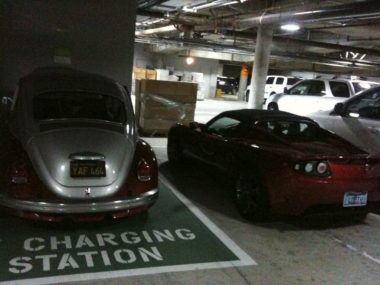
I don’t think I posted this to my blog…my caption was “Sorry Tesla, I got to the Charging Station first!”

IMG_2259.jpg \

Plug Bug: Drive to work data

Thursday, March 10th, 2011

My drive home includes ~1900′ of elevation gain, which takes a lot of energy. The car averaged 322 watt-hours/mile. So, what does the data look like coming too work where I drive *down* highway 17?

The controller reported 29.9 amp-hours used, which gives 229.4 watt-hours/mile. So, for my commute to work and back roundtrip, the average is: 276 watt-hours/mile. That gives a 111 mile range estimate to 100% Depth of Discharge. At a more conservative 80% discharge depth, that would be an 89 mile range when driving conservatively like I did during my test period. If I considered it as only taking 229 watt-hours/mile, it would be 134 miles to 100%, or 107 miles to 80% — but that isn’t realistic since I was driving mainly downhill on the way to work. But, a 100 mile average range might be doable if one sticks to relatively flat driving. Also note that I’m ignoring any extra draws on the battery, such as the 12v system (via the DC-DC converter) and the heater (which I wasn’t running). They easily take an additional 1-3% of the charge on my drive to work.

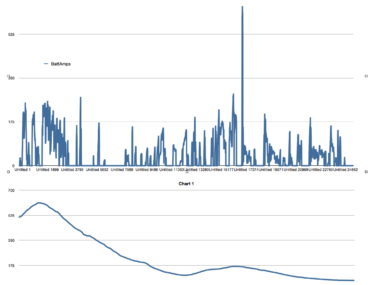
I mapped my drive to work, although I forgot to turn on the mapping until about a mile after I started driving. Here’s comparing the hills to the battery amps that the controller took:

Screen shot 2011-03-10 at 8.55.43 PM.png

Plug Bug: analyzing data

Tuesday, March 8th, 2011

I finally have the car running again! I got the controller back from Netgain Controls with an upgraded motherboard to fix some issues I was seeing. My Interface Module was also fixed to report the accurate voltage.

Here’s some data from the drive home as logged by the controller.

Total amp-hours consumed: 41.955 ah

Watt-hours, based on my 48 cell pack at 3.2v nominal, for 153.4v: 6444 watt-hours

Watts per mile, based on the 20-mile drive home, including highway 17 at 50-55 mph: 322.2 watts/mile.

That is what the controller is consuming; the battery has some extra draw to maintain the 12v battery via the DC-DC converter.

Let’s consider 322 watt-hours/mile as the average, although that was fairly conservative driving (not punching the throttle at lights, and coasting to a stop when I could).

The pack has: 48cells*3.2v*200ah = 30720 watts (30.7 kilowatts) of energy. At 322 watts/mile that would give a range of 95 miles. Give that I shouldn’t take the batteries lower than 20% depth of discharge (DOD) to get a high cycle life (and ensure I don’t kill cells), that give me a safe usable range of: 76 miles. Say 75 to be safe.

So, my range with my driving conditions is 75 miles. I could eek out 10 more if I really had to.

Here’s a graph of the voltage as I drove home. About 2/3rds the way through you can see it dropped quite a bit; that was driving up Highway 17:

Screen shot 2011-03-08 at 7.53.10 PM.png

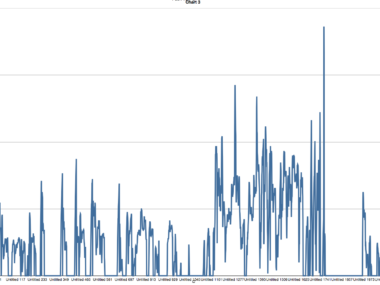
Here’s a graph of the battery amperage taken by the controller. You can see the spike when I drove up highway 17 (again, 2/rds the way home). At the end is a spike to almost 600 amps as I hit the throttle all the way for fun at the apex of the hill before coasting downwards to my house:

Screen shot 2011-03-08 at 7.56.05 PM.png

It’s also interesting to see the spikes before the highway 17 climb; those were probably stop lights.

Treehouse Fall Down – Video

Sunday, March 6th, 2011

This is a follow up to the last post where I posted pictures.


Treehouse Fall Down – Pictures

Saturday, March 5th, 2011

The main part of my old treehouse fell down quite some time ago. however, the walls were left standing until a while ago when they finally fell too. Here’s a few pictures. I’ll post a walk around video soon.

The old stairs and front deck (which still stands):

IMG_2312.jpg

The house, literally on its side:

IMG_2311.jpg

IMG_2309.jpg

Left of the North Pole: Aerial Cube

Saturday, March 5th, 2011

Here’s a video from the Aerial Cube section of our show we did last December 2010, called “Left of the North Pole”

Featuring Louise Lovelle and Allie Cooper.


(c) 2008-2012 Corbin Dunn

Corbin's Treehouse is powered by WordPress. Made on a Mac.

Subscribe to RSS feeds for entries and comments.

14 queries. 0.270 seconds.